UToledo Law Graduate Showcased Skills on Global Stage in Paris
Matt Mitten ’84 never intended to become an international sports law expert. When he entered The University of Toledo College of Law in 1980, he didn’t even take the sports law course, opting instead for corporate finance.
“I was probably one of the most naive law students that entered the school,” Mitten admits.
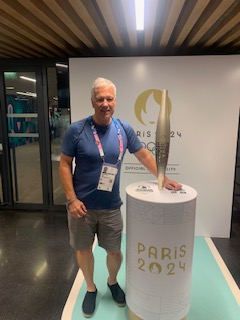
Mitten served in the the 2024 Summer Olympics, officially known as the Games of the XXXIII Olympiad, which was held in Paris, France, from July 26 to August 11. He was one of only 400 arbitrators worldwide for the summer Olympics on the Court of Arbitration for Sport (CAS) known less formerly as the world supreme court for sports, Mitten has found himself immersed in the world of sport. It is his third Olympic Games in this prestigious role, following assignments in Sochi, Russia (2014) and Tokyo, Japan (2020/21). Among the hundreds of arbitrators, fewer than 15 percent have ever been selected for Olympic duty.
“Sport allows us to see that we’re all in this together,” Mitten reflects. “Athletes from all different parts of the world compete under the same rules, and there’s a dispute resolution process that everybody respects.”

Mitten’s journey began with a teaching assignment in 1990. Fresh from practicing antitrust law at an Atlanta firm, he joined South Texas College of Law in Houston just as the dean faced a problem: 75 students had petitioned for a sports law course, but the field was so new that the first textbook wouldn’t be published until that summer.
“The dean asked me to develop a sports law course because he had a petition from 75 students basically demanding a course,” Mitten recalls. “Sports law was in its infancy; it wasn’t until that summer that the first sports law textbook came out. But I found having an antitrust and intellectual property background was a good base for sports law.”
That foundation proved important. Today’s major sports law developments, including the recent settlement allowing Division I universities to share revenues with athletes, stem from antitrust cases. “Like with college sports, that big settlement that’s going to allow Division 1 universities like The Ohio State, The University of Michigan, even Toledo, to share revenues with athletes, that’s the result of an antitrust case,” he explains.
Olympic arbitration operates under intense pressure. Athletes’ careers can hinge on decisions made in hours, not months. When an athlete tests positive for a banned substance or disputes competition results, CAS arbitrators must act swiftly.
“It’s designed so that if an athlete has a dispute regarding competition results or tests positive for a banned substance, they get an opportunity to present their case before they’re excluded from any further participation in the Olympic Games,” Mitten explains. “Which is very important, because the athletes have a right to be heard before an independent, impartial arbitrator.”
In Russia, Mitten’s panels resolved 33 cases. The experience taught him to balance due process with speed, ensuring athletes receive fair hearings while delivering decisions quickly enough to matter for ongoing competition.
“After three times, I’m just able and more comfortable working very quickly. You’re balancing due process, providing full and fair hearing with a good, correct and fair decision.”
That ability to weigh fairness and precision under pressure had roots in his earliest legal education at The University of Toledo College of Law with Professor Ron Raitt. When Mitten told Raitt during his first week that he wanted to be an antitrust lawyer and law professor, the professor’s response was direct: “Well, that means you have to get good grades, and antitrust is typically done by big firms in big cities. You better be top of your class.”
“I remember meeting with him the first week of school. I told him I wanted to be an antitrust lawyer after an undergraduate degree in economics from Ohio State,” Mitten recalls. “That was the genesis of it. I knew what I wanted to do, but I never thought I would accomplish both objectives so quickly.”
The relationship lasted 30 years, until Raitt’s death. In 2015, Mitten endowed a scholarship in his mentor’s memory.
“Professor Raitt was very patient and helpful. We became good friends after law school, and he was always a mentor,” Mitten reflects. “Without him and his guidance, I wouldn’t have been able to take the path I did or have become as successful.”
Now established in his teaching career, Mitten remains struck by how few students take advantage of faculty mentorship.
“I’ve been a law professor for 36 years. Not enough students take advantage of that,” he observes. “You talk to faculty and alumni who are happy to talk with students, but the students just don’t do it. That person might open up avenues you hadn’t thought of to help get you to your objective.”
The guidance he received at Toledo Law wasn’t just about coursework; it was about seeing possibilities he never would have imagined. “It’s hard to believe that it’s been, what, 40 years since I was a student. But if I look back, a lot of schools offer the same courses that I took; it was the guidance from the faculty outside the classroom and their willingness to do that which played a very significant role in helping me go down the path that I ultimately took.”
With passion and commitment, the once naïve law student ended up shaping global sports policy at three Olympic Games and for future generations of law students.